Posts

Aggressive Tapering?
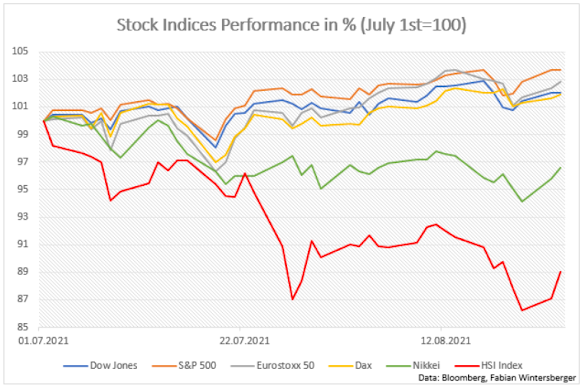
Image
After a short summer break I welcome all readers back to my weekly review and hope that, despite the not so sunny weather, everyone of you had a 'great summer'. However, summer was good for most investors if one was invested in European and American markets. There are not many days, where the big indices are not making all-time highs.  On the other hand, the summer was not that good for those who invested into Asian markets: Japan has been struggling with a rise in covid cases, which may has led to a four per cent decrease in the Nikkei compared to the beginning of the summer.  In recent weeks, China has started to lock down some regions again due to an increase in covid cases which may be a bad sign for the world economy. Although much more negative has been the rising interference of the communist party to specific chinese enterprises. As a result, they faced an intense sell-off of their stock. As the main engine of the world economy is struggling, and this has implications ...

Back To Normal?

Image
After yields have traded within a range for a couple of weeks now, one could observe a rise in demand for government bonds (US & Europe) this week and, vice versa, a fall in yields. German 10y Bund yields are back below -.30 % at April levels. Within the current week, 10y Bund yields have fallen more than 10 bps. Bund yields follow the move of US rates, where US 10y Treasury yields are down nearly 20 bps since July 1st. A possible potential bull flag has dissolved on the downside. Instead of a further rise in yields, as some may have expected in face of currently high inflation numbers, yields fall on the mid and the long end of the curve. In the stock market, the fall in yields has led to a rotation back into growth stocks, away from value stocks. Especially tech companies benefited from a fall in yields on the long end of the curve. If one looks at the Nasdaq-100 ( 100 biggest companies on the Nasdaq ) and the Dow Jones Industrial Average, one sees that growth stocks have been un...

The Case For Deflation?

Image
No matter where one is standing in the ongoing inflation vs. deflation debate, one should always listen to the other side’s arguments. That is why this week’s topic will be deflation.   Before I want to discuss today’s arguments for a continuation of the current deflationary economic environment, let us look at the theory at first.   Nowadays the term ‘deflation’ is used synonymously for price deflation, a general decrease of prices.   Basically, falling prices can have two possible causes: either the fall in prices is caused by a falling supply of money in a currency area or by an increase in productivity, which is a rise in the quantity of goods produced. In the second case, price deflation is expressing a rise in the standard of living of the population and therefore something positive.   However, if the gold standard would still be in play, a current account deficit would lead to an outflow of gold to a country with a current account surplus. While the money supp...

The End of Neoliberalism

Because of the fact that markets are already in summer mode, I want to discuss a topic with a more philosophical and economic background today: Liberalism, respectively, the crisis of liberalism that we face these days. Whether we revert to fundamental liberal principles will definitely play a role in how our economies will perform in the future. However, the current zeitgeist suggests that politics, with democratic legitimacy, will take a different path or has already taken it. During its history, proponents of the liberal theory have always compromised by accepting social democrats and interventionists. While the intent is understandable, it has not convinced the general public that liberalism (economically and socially) is the right way to choose. Additionally, the liberal idea is not an idea that is inspiring young people. Most youths praise an interventionist, socialist economic model, whether one calls it Lifestyle-leftism (Sara Wagenknecht) or democratic socialism  (Alexandr...

Underestimated Risks

Image
Now that I have written about the theory and history of stagflation and inflation  for 2 weeks, this new weekly commentary is dealing with actual market events. Nevertheless this commentary could be linked to the last two. Within all the discussions about inflation and current all time highs in equities one could get the impression that the vast majority of analysts, economists and investors are anticipating higher inflation to come.  Contrawise, a recent global fund manager survey by Bank of America, whether the participants think that inflation is either transitory or permanent, shows a different picture. 72 % of the participants think - alike the Federal Reserve - that inflation will indeed be transitory and will diminish in the coming months. Inflation is transitory, the economy is growing at a high rate and equity markets will profit from this environment , so the majority thinks: According to the survey only 2 % expect a coming bear market in the S&P 500 within the ...